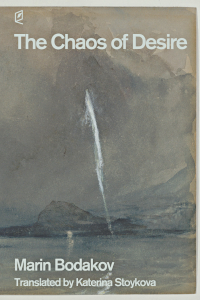
The Chaos of Desire
This collection of poems by late Bulgarian poet Marin Bodakov, selected and translated by Katerina Stoykova, brings to English language readers Bodakov's minimalistic style—a few sparse words, each integral to building the structure of the poem. Nothing excessive or gratuitous. Yet somehow, the atomic cage of the poem unlocks something inside the reader—releases the trapped energy of unsaid truths.
"Bodakov's poems rank alongside those of his contemporary surrealist masters—Charles Simic, Mark Strand, Octavio Paz, Nicanor Parra. Deftly translated by Katerina Stoykova, each work is spare, sinewy, full of small but powerful surprises that induce you to blink, pause, begin again. These are poems to linger over. Each reading brings new rewards."—Andrew Merton
From the Book
Passing Manifesto
What Others Say
Bodakov's poems rank alongside those of his contemporary surrealist masters—Charles Simic, Mark Strand, Octavio Paz, Nicanor Parra. Deftly translated by Katerina Stoykova, each work is spare, sinewy, full of small but powerful surprises that induce you to blink, pause, begin again. These are poems to linger over. Each reading brings new rewards.
Marin Bodakov's The Chaos of Desire launches a battle with small, powerful poems that span a lifetime. Desire for love, a parent, lost home, yearning in chaos of destruction, the poet searches for meaning. "This book supplies the light," as it spans the evolution of a man facing mortality, seeking inner children, reconciling loss and love. A glorious collection glimmering with images of the sea where peacefulness is sought. Poems to be cherished as it defines, "chaos, which pronounces the unpronounceable" offered with grace and dignity, beauty and mastery.
In The Chaos of Desire, Katerina Stoykova renders the poetry of the late Marin Bodakov into a spare and polished English. Both he and she have honed the art of brevity and compression. So she is especially deft at bringing him into English. This collection pulls poems from Bodakov's various books to give us a portrait of a poet over the course of a life in writing, a portrait that is also an elegy for a man who cataloged longing and grief, loneliness and loss like few others. And though these poems circle around loss, absence, and failure more than any other feeling, they are not poems that give up in despair. No, a macabre, self-deprecating humor and wit enlivens them. And even more, the voice of these poems are tinged with compassion. Bodakov sings of a body that longs to forgive and be forgiven, "to make peace while we're still here." He sings of a man that seeks friendship and communion, of a son who mourns the death of his father. His poetry is like the "Guileless sky" he writes about, one that "turns sins into mistakes, wine into water. Me into you." Let us sit under that sky for a while and drink the water he gives us.
About the Author