
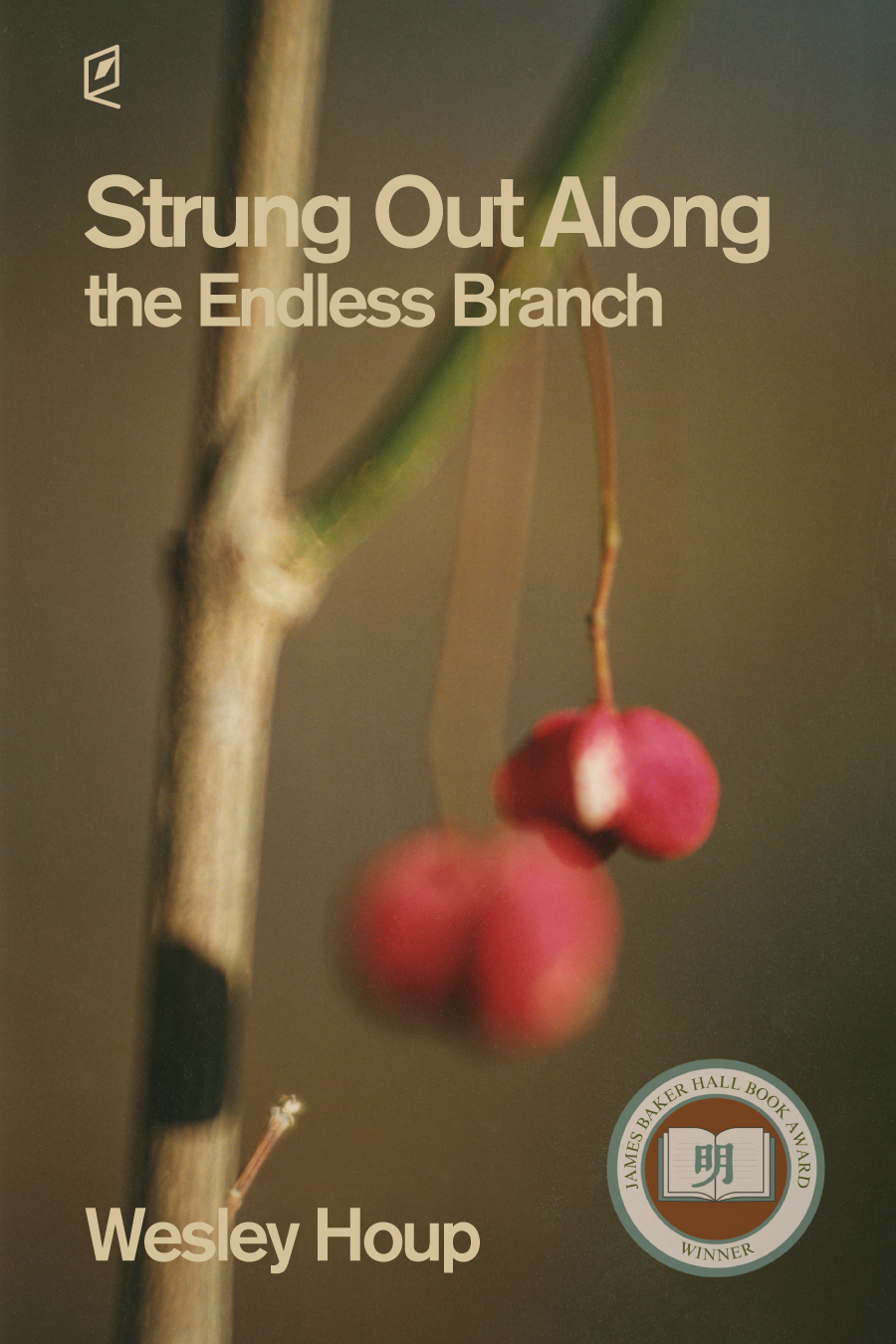
Strung Out Along the Endless Branch
Strung Out Along the Endless Branch was selected by Greg Pape as the winner of the inaugural James Baker Hall Book Award. Accents Publishing is proud to present this debut collection by a brilliant poet, philosopher and observer of both human nature and the natural world.
"Wesley Houp has a way of sketching a scene or telling a tale so that the imagined backstory, what isn't said but lurks just outside the poem's words, carries the emotion and meaning and keeps resonating. Emily Dickinson said, "Tell all the truth but tell it slant—". The poems in this book seem to follow that advice. It is a book of poems with its own charmed, often fabulous (in the sense of fable-like) way of evoking and presenting contemporary realities and absurdities, garbled politics, drugs, dangers and divisions of all sorts, but also, the rich particulars, characters, and daily wonders of this world."—Greg Pape
From the Book
Another Gladelarking
What Others Say
What a joy to read G. Wesley Houp's book, Strung Out Along the Endless Branch. My favorites among the poems read like the fables found in folk music; their narratives and imagery both delight and trouble the reader. Other poems draw from history and biology, then sometimes veer into the surreal. Several poems are populated by Houp's children and those of his neighbors, who act as the magic, promise and thermometer of their society. "Infinity Girl," for example, observes his daughter on a swing: "a circuit of momentum//as harmless as a small body of light/that illuminates the playground." This is followed by "The Future," that begins "There goes the/NARCAN truck." The tension between the rural and the urban is introduced in the very first poem: "The school bus winds down/Laura Thompson Trail/plucking up the forest children/and trundling them off/to school in town." Houp's close attention to the native flora and fauna around him recalls the poems of James Baker Hall, the wonderful Kentucky poet and artist. In fact, Strung Out Along the Endless Branch is the first recipient of the new book award in Hall's name.
Wesley Houp has a way of sketching a scene or telling a tale so that the imagined backstory, what isn't said but lurks just outside the poem's words, carries the emotion and meaning and keeps resonating. Emily Dickinson said, "Tell all the truth but tell it slant—". The poems in Strung Out Along the Endless Branch seem to follow that advice. It is a book of poems with its own charmed, often fabulous (in the sense of fable-like) way of evoking and presenting contemporary realities and absurdities, garbled politics, drugs, dangers and divisions of all sorts, but also, the rich particulars, characters, and daily wonders of this world. It is a pointed, yet tender, pasquinade or satire, moving, thought provoking, insightful, funny, heartbreaking.
W. Houp is a Revelator. He seems to know instinctually that poems are not an "expressing," or even primarily a "creating," but foremost an in-seeing, a result of attending so intently to the objects and experiences of the world, in all their urgent, opaque materiality, that they finally open to reveal the luminous and illuminating hidden in them. Every poem in this robust collection achieves this, their sparse, refreshing clarity bespeaking an eye and mind and art that will settle for nothing less, or more, than the vital and vitally essential, which reveals itself, and which the poet so profoundly captures in poem after poem, with the frequently excruciating quietude and grace of the sacred—all the more sacred for the very mundanity of the objects and moments so lovingly, humbly, and artfully retrieved, preserved, and gifted to the reader, who can only appropriately respond with wonder and gratitude for the revelation.
Wesley Houp has shown us, in this collection of poetry, a way to discover poems—hidden everywhere, if we are alert enough to notice them.
About the Author